Three streams. One record. Kept on your device.
Surveys ask, games measure, tools get practiced. Every answer, round and rep writes to the same record.
Each one writes a different kind of evidence.
All three write to the same record.
AssessSurveys
23 surveys
Scored on the device, banded rather than ranked, and compared only against your own earlier takes.
- Every answer, kept on the device
- A score on each of 77 dimensions across the set
- A band, low or balanced or high, never a rank against a stranger
TrainBrain games
75 games
Every round writes a row. Puzzles write a different one: no score, and a slower solve is the worse result.
- Score, accuracy, and mean reaction time
- The stage you reached and how long you held it
- One row per ability the round moved
- Solve time against par, for the grid puzzles
ApplyMental tools
133 tools
A tool is practiced, not read. Reps get recorded, and they roll up into ten life skills.
- Each run, with the mode it ran in and how it went
- Standing practices and the days you kept them
- Real-life habits, and how they actually landed
- Repeats at one, three, seven and sixteen days
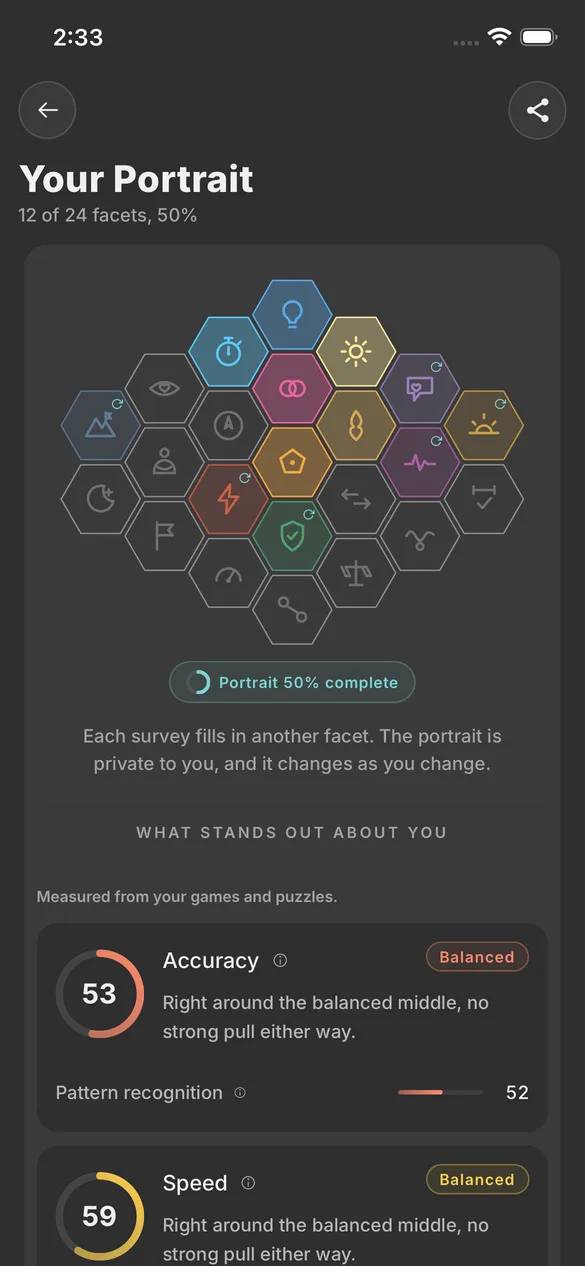
Six abilities, twenty one areas, one hundred and seven sub skills.
One round of one game does not produce one number. It resolves down the ladder, and every level keeps its own history.
6 Headline abilities
Accuracy, Speed, Memory, Focus, Comprehension, Periphery. The six axes of the radar, and the level most apps stop at.
21 Brain areas
A browsable middle layer, from working memory and impulse control to visual search and timing. Curated, not generated.
107 Sub skills
What a single round actually moved. Every game declares the sub skills it trains, and each round scores against them.
The streams are read together, not side by side.
A tool you practiced on Tuesday, a check-in on Wednesday afternoon and a game round on Wednesday night are three rows in the same record.
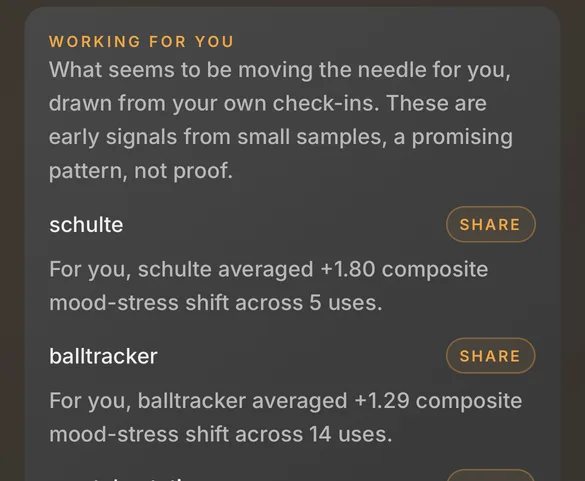
Which tool actually moved your mood
A practice is paired with the check-in up to six hours before and the first one up to eighteen hours after, and the shift between them is averaged.
Two pairs to show it. Five, and a clear lift, before it is called a signal.
Which kind of tool helps you most
The same pairing, rolled up by category, so a habit shows before any single tool has enough runs.
Three pairs per category.
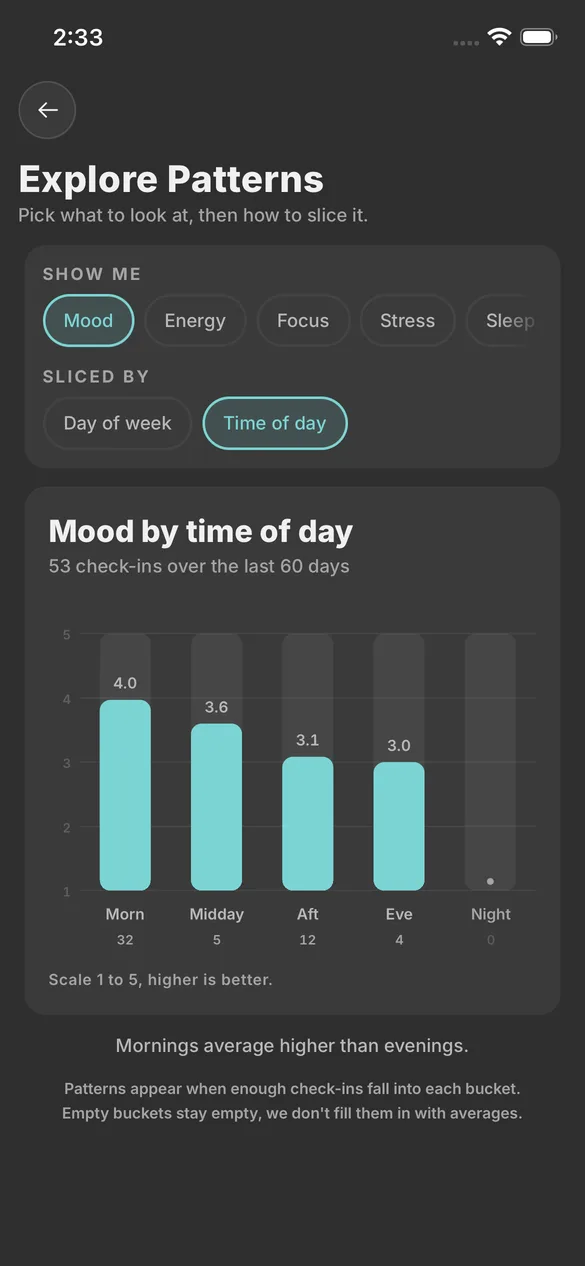
Your sharpest window in the day
Check-ins fall into buckets by the hour they were written, and the buckets are compared.
The best has to beat the worst by a clear margin, or nothing is said.
Your steadiest and heaviest weekdays
The same readings sliced by day of the week instead of hour.
Two per weekday, and a real gap between them.
Whether your training load is outrunning you
Your week of harder sessions, set against the direction your own stress readings are moving.
Says "not enough yet" rather than guessing.
Whether a suggestion you took changed anything
A recommendation is logged when it appears and when you tap it, along with the check-ins that follow.
Measured against your own later readings, not against a promise.
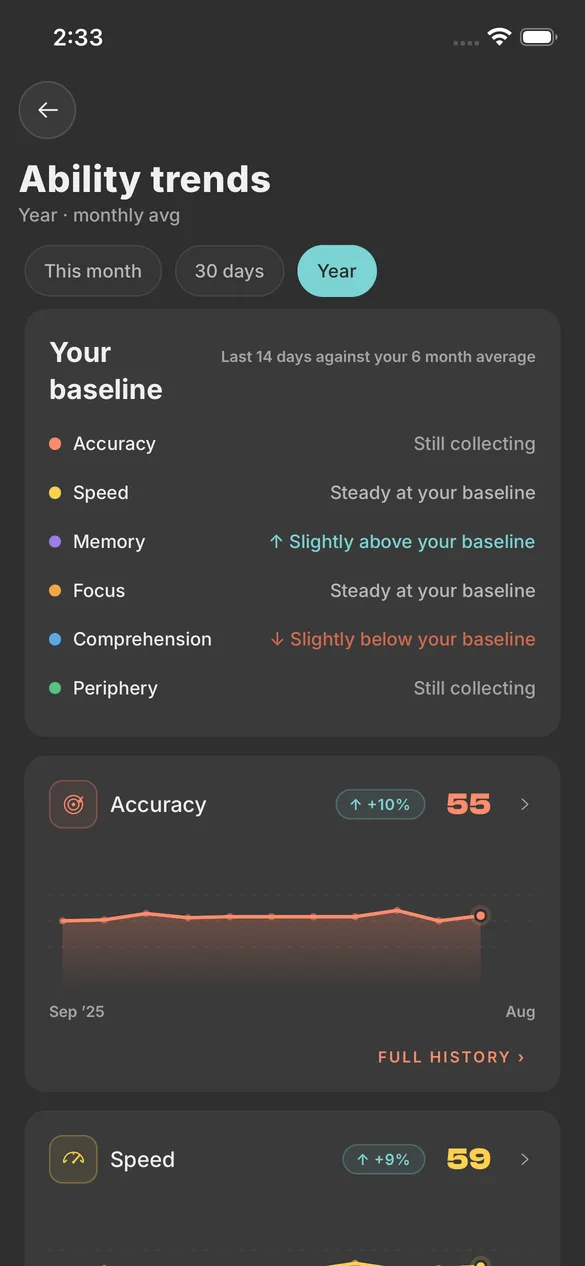
This is your own record, averaged over your own weeks. Below its floor, each reading stays quiet.
Any number here opens into its own record.
Six kinds of stat, one addressing scheme. Whatever you tap, you get the whole series, your record, and the day it happened.
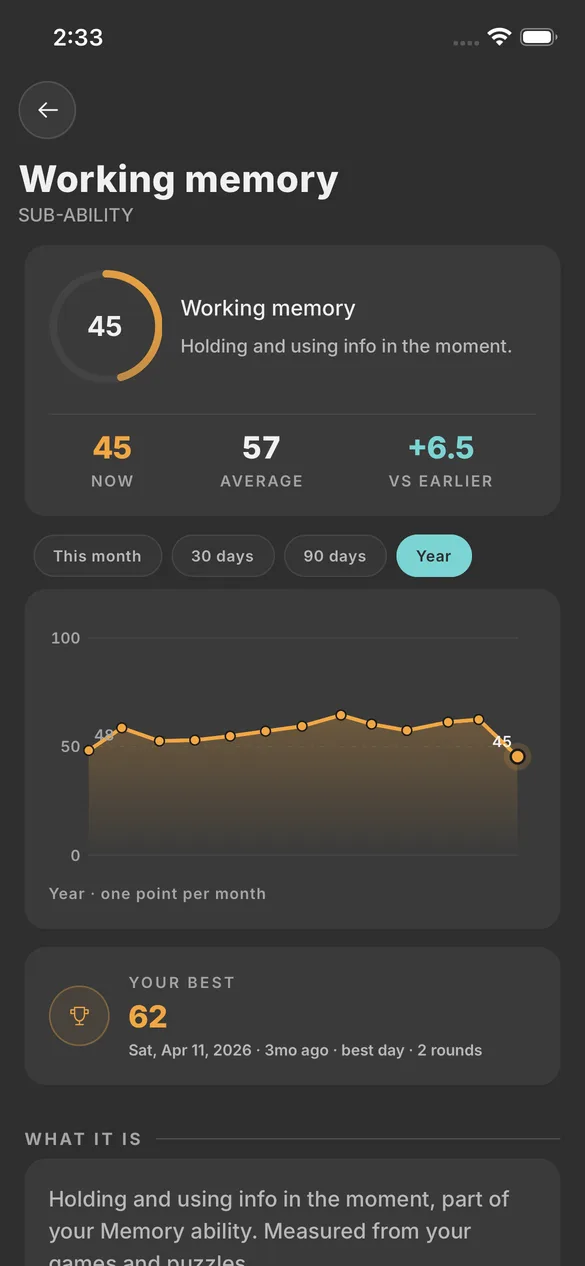
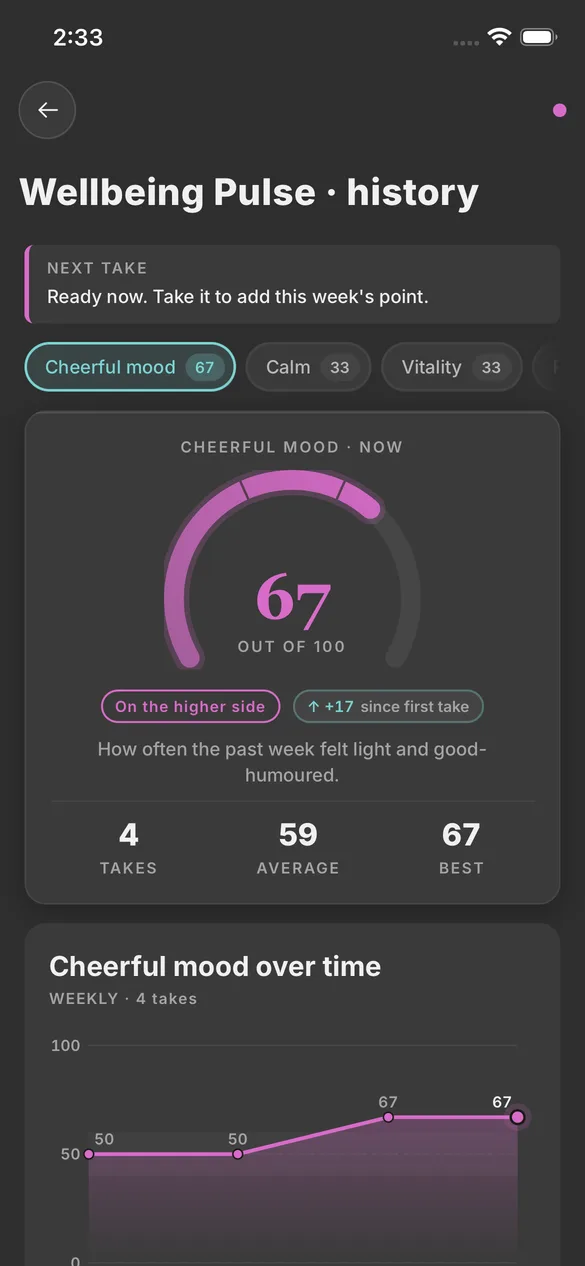
- an ability
- a survey quality
- a game
- a puzzle
- a tool
- a life skill
Puzzle solve times run the other way, and the charts know it: a faster solve never reads as a decline.
Free covers the current calendar month. Premium opens the full year, the view shown above.
26 of the games, 47 of the tools and 8 of the surveys are free, and they record the same way.
Everything above is computed on your device.
A record this detailed is only worth keeping if you are the one keeping it.
The analysis runs on your phone.
No scoring server, no language model, anywhere in the path.
Sync is optional, and it leaves encrypted.
Turn it on and your record travels between your own devices, encrypted before it goes. What sits on the server is a blob the server cannot read.
The web backend can read nine fields.
All of them are aggregates: a date, your metric summary, level, streak, session and game counts, and badges. A tenth field does not get quietly stored: it fails the build.
It does not reach for anything else.
No health data, no location, no contacts, no motion sensors, no advertising id. Sleep is something you tell it, not something it takes.
What a record like this does not entitle us to say.
The measurement is real. The conclusions people usually sell on top of it are not.
The comparison curves are modeled, not a census.
A percentile or a brain age compares you against a published distribution, not against other people using mindima. The screen says so, and the number is a ballpark.
A pattern is a signal, not a finding.
Every connection here is a difference between two averages over a window of your own data. Not a statistical test, not clinical, not a diagnosis.
In-app measurement is in-app measurement.
We can tell you what changed in the task you trained. What that means for the rest of your life is contested, and we will not claim it.
Start the record.
Play before you sign up. What it records is yours from round one.
Coming soon to iOS & Android