 From Memra · Memory
How Sequence Memory works
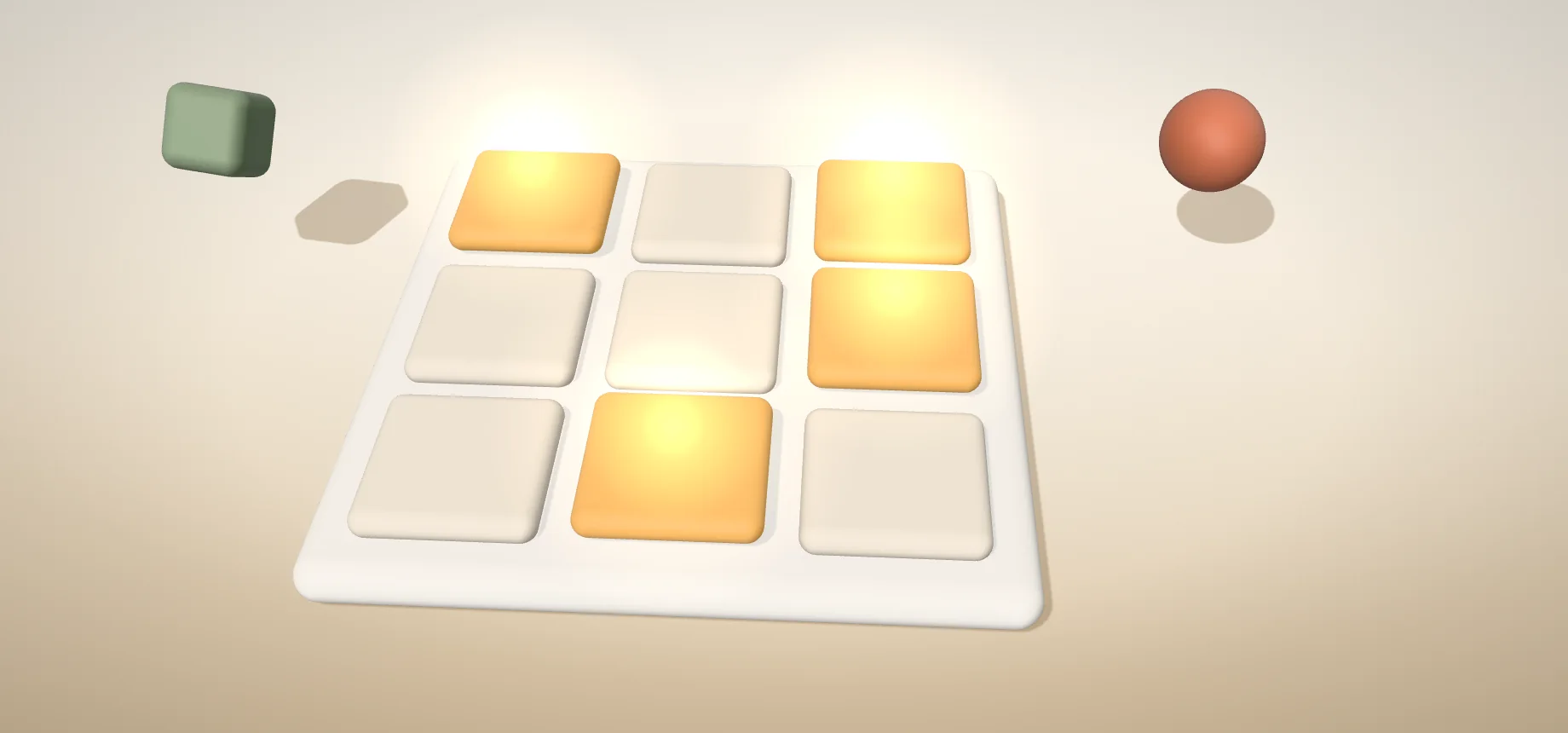
Squares on a 3 by 3 grid light up one at a time. When they stop, tap them in the same order.
The first sequence has 3 squares. Repeat it cleanly and the next one is a square longer. You get two tries at each length; miss both and the run ends. Your score is the longest sequence you repeated.
What is a good score?
The classic version of this task is the Corsi block-tapping test, where an examiner taps a sequence on nine blocks. In a standardization study of 70 healthy adults, the average block span was about 6.2.
This version uses a regular grid on a screen instead of irregular wooden blocks, so treat that figure as a rough guide. This is a game, not a clinical test.
Three tips
- Follow the path the squares trace, as a shape, rather than counting positions.
- Say the positions quietly to yourself, like top left, middle, bottom right.
- Wait for the last square before you start tapping.
Questions
Is this the Corsi test?
It works the same way as a forward Corsi block-tapping task: watch a sequence of positions, then repeat it in order. It is a game made from the Memra app, not a clinical assessment.
What is a typical score?
On the standard Corsi task, healthy adults averaged a span of about 6.2 (Kessels et al., 2000). Scores on this grid can differ.
How many tries do I get?
Two at each length. A clean repeat moves you up one square; two misses at the same length end the run.
Using this in class? See Mindima Play for teachers.